
Mein Schiff 3 Crash in Bremerhaven: Your Rights If a Cruise Ship Collides
A cruise ship collision is rare, but what you do afterward still matters. Here is what is known so far, and the steps passengers can take if it ever happens to them.
TL;DR:
- What happened. On October 25, 2026, a gust of wind pushed TUI Cruises’ Mein Schiff 3 into two container ships as it left Bremerhaven, Germany.
- No injuries were reported. Police and the cruise line said no one was hurt, but the damage led to the cancellation of a 20-night voyage.
- The cause is not settled. German police are investigating, including the captain’s conduct, and an investigation is not a finding of fault.
- If a collision does hurt passengers, responsibility in passenger accident claims on cruise ships can reach the cruise line, pilots, tug operators, the other vessel, the port or equipment makers.
- Anyone aboard a ship in a collision should get checked, report any injury and keep records, even if they feel fine, because the first 24 hours after a cruise injury often shape what can be proven later.
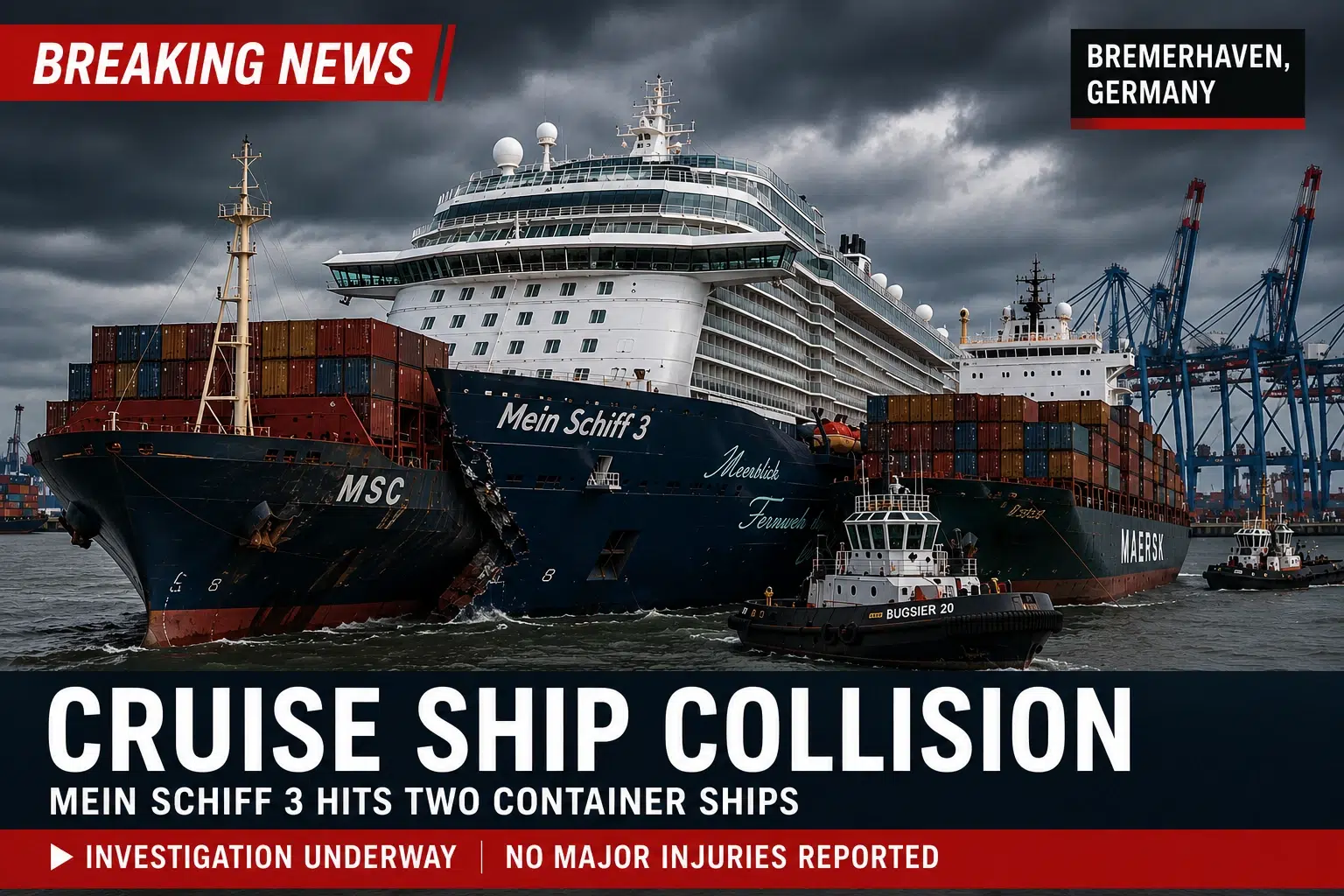
A cruise ship collision is rare, but the Mein Schiff 3 incident in Bremerhaven, Germany, has put an uncomfortable question in front of thousands of travelers: what happens to passengers when a ship hits another vessel? On Sunday, October 25, 2026, a gust of wind pushed TUI Cruises’ Mein Schiff 3 into two container ships as it left port. Police and the cruise line reported no injuries, but the damage was serious enough to cancel the voyage.
We are not suggesting that anyone has a claim from this event, and its cause is still under investigation. What we can do is explain what is known, what the terms mean, and what any passenger should do if a collision happens on their cruise, whichever of the cruise lines option they sail with.
What happened in Bremerhaven
According to police and the reports that followed, the Mein Schiff 3 was leaving the Columbus Quay cruise terminal with tugboats helping when a strong gust of wind pushed it toward two container ships moored nearby. The table below sets out the main facts as reported.
| Item | What has been reported |
|---|---|
| Date and time | Sunday, October 25, 2026, at about 5:30 p.m. local time |
| Place | Bremerhaven, Germany, as the ship left the cruise terminal for the Canary Islands |
| People aboard | 2,428 guests and 922 crew, according to TUI Cruises |
| Injuries | None reported by police or TUI Cruises |
| Damage | Lifeboats, cranes and hull on the cruise ship. Several meters of one container ship’s side torn open. No water ingress reported on any of the three ships. |
| The voyage | A 20-night Canary Islands round trip was cancelled after inspections found the ship needs shipyard repairs |
| Investigation | Bremen police are investigating, and German authorities barred the three vessels from sailing until cleared |
The ship returned to the terminal, and public reports say passengers were first allowed to stay aboard while the damage was checked, then left the ship the next day. Reports citing TUI Cruises give the passenger and crew figures, and note that the cause and the full extent of the damage had not been established.
Video: news footage of the Mein Schiff 3 collision in Bremerhaven.
What is known, and what is not
The basic facts above are consistent across police statements and news reports. Early accounts differed on whether one or two container ships were struck, but police said two. Beyond that, a lot remains open.
- Known: the date, the weather, the number of people aboard, the damage reported so far, the absence of reported injuries and the cancelled voyage.
- Not known: the exact cause, what forecasts and warnings were available, how the departure decision was made, and what role the tugs played.
German police have opened an investigation into the captain, which news outlets have reported is about a possible breach of the duty of care. An investigation is not a finding. Strong wind was part of the picture, but wind alone does not answer whether decisions made before and during the departure were reasonable. That is exactly what investigators look at, and none of us should guess ahead of them.
Collision or allision: what the words mean
News reports call this a collision, and that is how most people use the word. In maritime law, the terms are more precise. A collision usually means two vessels that are both moving. An allision usually means a moving vessel striking something that is not moving, such as a pier, a bridge or a vessel tied up at a quay. Because the container ships were reportedly moored, some lawyers would describe this event as an allision.
The difference is not just vocabulary. The legal rules that decide who is at fault can differ depending on how the event is classified, and a moving vessel that hits a stationary one often faces tough questions about why it could not avoid it. That is one reason a careful investigation comes before any conclusion.
Why departures in strong wind are risky
A modern cruise ship is tall, with a large surface area above the waterline that wind can push against. Leaving a berth is one of the most delicate moments of any voyage, because the ship moves slowly, close to other vessels and structures, and relies on thrusters, tugboats and a pilot to stay on course. A strong gust at the wrong moment can move a ship sideways faster than the crew can correct.
For that reason, whether and when to leave in rough weather is a serious decision. Captains, pilots and port authorities weigh the forecast, the warnings in force and the ship’s own limits. When something goes wrong, the question that follows is usually what a reasonably careful operator would have done with the information available at the time.
This is general information based on public reports. No finding has been made about the cause of this collision or who, if anyone, was at fault.
If you are aboard a ship in a collision
Whether or not you were hurt, the first hours matter. If you are ever on a ship that has a collision, these steps protect both your health and your options.
- Follow the crew’s instructions. Stay where you are told to stay, and do not go back for belongings if you are asked to wait.
- Get checked, even if you feel fine. Head, neck and back injuries can show up hours or days later. A visit also creates a dated record, and it helps to know what cruise ship medical care can realistically cover, since the ship’s medical center may be limited in what it can treat.
- Report any injury to guest services or security, ask for a copy of the incident report and note the name of the person who took it.
- Photograph what you can. That includes damage, debris, your injuries and any notices, and screenshots of messages from the cruise line.
- Collect names. Get the contact details of witnesses and the names of crew who helped you.
- Write down what you felt and saw, with the time and your location on the ship, while it is fresh.
- Keep receipts for medical care, transport, hotels and any other costs the incident caused.
- Read before you sign. Some compensation offers, such as a credit toward a future cruise, come with a form that releases the cruise line from claims. Get advice first.
These steps matter most in the first 24 hours after a cruise injury, when memories are fresh and evidence is still on the ship.
Hurt on a cruise, anywhere in the world?
We can tell you who may be responsible and which deadlines apply. The call is free.
Who may be responsible when passengers are hurt
Nothing reported so far suggests passengers were hurt in Bremerhaven. But if someone is injured in a ship collision, the people who may share responsibility are often more than just the cruise line, and it depends on what investigators find.
- The cruise line. It owes passengers reasonable care, which includes the decisions its officers make about weather, speed, staffing and equipment.
- Pilots and tug operators. If their actions or equipment contributed, their companies may carry their own responsibility.
- The other vessel. Its owner or operator may be responsible if its mooring, position or conduct played a part.
- The port or terminal. Conditions at the berth, the layout and the services it provides can matter.
- Equipment makers and maintainers. If lifeboat davits, glass barriers or other fittings failed, the makers or those who serviced them may be involved.
More than one party can share fault for the same event, and each can have its own deadlines, so it helps to know who to notify and who to sue after a cruise injury. Passengers hurt in a collision may have passenger accident claims on cruise ships against more than one company. Where a lawsuit must be filed, and how fast, is usually set by the ticket, which is why where you can sue a cruise line matters so much.
Injuries from a collision can be very different from the most common injury on a cruise ship that passengers report on board. A collision is more likely to involve sudden jolts, falls and objects that break loose.
When a cruise is cancelled
For most passengers on the Mein Schiff 3, the main effect was a cancelled holiday, not an injury. Some passengers told a German broadcaster they were unhappy about when the cancellation was announced, and TUI Cruises had not answered questions about how it informed passengers at the time of that report. The company said it regretted the disappointment and that canceling was the responsible choice.
A cancellation is separate from an injury claim. Whether you get a refund, a credit or compensation depends on your ticket contract, the cruise line’s cancellation policy and the law where you booked. For those questions, start with the cruise line, your travel insurer and your card issuer, keep your booking records and receipts, and read any offer carefully before accepting it.
Frequently asked questions
Was anyone injured in the Mein Schiff 3 collision?
According to Bremen police and TUI Cruises, no one was injured. Reports say none of the three ships took on water. The investigation is still ongoing, so details could change.
Who is responsible for the Mein Schiff 3 collision?
That has not been determined. German police are investigating, including the captain’s conduct, and strong wind was reported at the time. An investigation is not a finding, and wind alone does not decide whether the decisions before the departure were reasonable.
What should I do if I am hurt in a cruise ship collision?
Get medical care, report the injury to ship security or guest services, photograph the damage and your injuries, collect witness names and keep your ticket and receipts. Do not sign a release before you get advice, and check your ticket for notice deadlines as early as possible.
Can I get a refund if my cruise is cancelled after a collision?
That depends on your ticket contract, the cruise line’s cancellation policy and the law where you booked. A refund is separate from an injury claim. Keep your booking records and receipts, and ask the cruise line, your travel insurer and your card issuer what they cover.
This article is for general information only and is not legal advice. Reading it does not create an attorney-client relationship. It is based on public reports available on October 31, 2026, and no finding has been made about the cause of the incident. Every case depends on its own facts and the terms of the passenger ticket.
Hurt on a cruise?
Most cruise tickets give you one year to file. Talk to a maritime attorney about your case today.
Call (888) 866-5303Free and confidential
Related practice areas
More from the blog
All articles
268 Sick on the Caribbean Princess: Norovirus Confirmed After the Ship’s Second Outbreak This Year
The CDC now reports 268 sick on Princess Cruises’ Caribbean Princess and names norovirus as the cause. See how the count grew and what to do if you get sick on a cruise.
Man Overboard From Royal Caribbean’s Allure of the Seas: What Has Been Reported and How the Search Works
A man went overboard from Royal Caribbean’s Allure of the Seas off the Bahamas and the ship turned back to search. Here is what was reported and how overboard searches work.
Coast Guard Airlifts Passenger From Holland America’s Koningsdam: What Happened 80 Miles Off San Diego
The Coast Guard airlifted a 74-year-old passenger from Holland America’s Koningsdam about 80 miles off San Diego. Here is what was reported and how airlifts at sea work.
0 Comments