
Coast Guard Airlifts Passenger From Holland America’s Koningsdam: What Happened 80 Miles Off San Diego
A 3 a.m. call, an 80-mile helicopter flight and a hoist off a moving ship: what happened and what passengers should know.
TL;DR:
- What happened: A 74-year-old passenger on Holland America Line’s Koningsdam had symptoms consistent with a heart attack about 80 miles west of San Diego on November 20, 2026, and the Coast Guard airlifted him to Scripps Memorial Hospital.
- How fast it was: The Coast Guard was called around 3 a.m., and the helicopter reached the ship around 5:45 a.m.
- What the cruise line said: Holland America reportedly said its medical team gave intensive care on board and that the benefits of immediate care ashore outweighed the risks of a helicopter evacuation.
- What is not known: The passenger’s name, his condition and the ship’s itinerary have not been released.
- If it happens to you: Ask for your records, keep every bill and get advice early, because deadlines for a claim can be short.
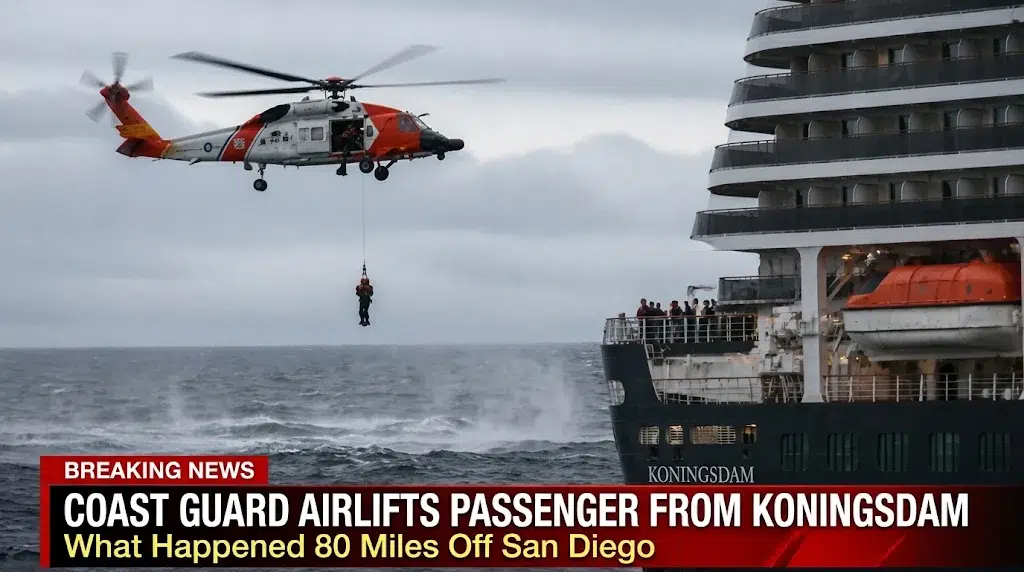
At about 3 a.m. on Friday, November 20, 2026, the captain of Holland America Line’s Koningsdam called the U.S. Coast Guard. A 74-year-old passenger was showing symptoms consistent with a heart attack, and the ship was about 80 miles west of San Diego, too far for an ambulance and far enough that the fastest route to a hospital was by air.
This article explains what has been reported, how a Coast Guard airlift from a cruise ship works, what a ship’s medical center can and cannot do, and what passengers and families should know afterward. It is based on public reports and statements. It does not say that Holland America or anyone else did anything wrong, and nothing in the reports suggests that.
What Happened on the Koningsdam: A Timeline
The Koningsdam is a 983-foot Holland America Line ship in the Pinnacle class, flying the Dutch flag. According to NBC 7 San Diego, People, the New York Post (republished by Finwire) and RusTourismNews, the evacuation unfolded like this:
| When | What was reported |
|---|---|
| About 3 a.m., Friday, November 20 | The ship’s captain contacted Coast Guard Sector San Diego about a 74-year-old man with symptoms consistent with a heart attack, about 80 miles west of San Diego. |
| Shortly after | Watchstanders consulted the duty flight surgeon and launched an MH-60 Jayhawk helicopter crew from Coast Guard Air Station Ventura. |
| About 5:45 a.m. | The helicopter reached the ship, and the crew hoisted the passenger off the deck in a basket stretcher. |
| Afterward | He was flown to Scripps Memorial Hospital in La Jolla. His luggage was reportedly airlifted separately. |
| Sunday, November 22 | The Coast Guard released video of the hoist, recorded on November 20. |
That is roughly two hours and 45 minutes from the first call to the helicopter arriving over the ship. Lt. Aiden Becker, a search and rescue mission coordinator at Coast Guard Sector San Diego, said responding to medical emergencies aboard vessels far offshore “requires careful coordination.” The passenger’s name and nationality have not been released, no final diagnosis has been confirmed and no update on his condition had been reported. The ship’s itinerary was not given either.
Video: footage related to the Koningsdam airlift. Watch it on YouTube if the player does not load.
How a Coast Guard Airlift From a Cruise Ship Works
The Coast Guard does not simply send a helicopter when a ship asks. In this case, officials first consulted a flight surgeon, which is standard in medical evacuations. Several points apply on almost every airlift:
- The captain makes the request: The ship’s medical team and captain decide help is needed and contact the Coast Guard.
- A flight surgeon weighs in: The Coast Guard consults a doctor on whether an evacuation is needed and how urgent it is.
- Distance matters: Helicopters have a limited range, so a ship far offshore may need to sail toward the coast. Here the ship was about 80 miles out.
- The hoist is the risky part: The helicopter hovers above a moving ship while a basket or litter is lowered, which is why the ship’s crew and the aircrew have to coordinate closely.
- The risk is weighed: Holland America reportedly said the evacuation went ahead because the benefits of immediate care ashore outweighed the risks of a helicopter evacuation.
The same process played out when a Norwegian Bliss passenger was airlifted by the Coast Guard, and three medical evacuations in five days on the Quantum of the Seas show how the method changes with the rescuers and the distance.
What a Ship’s Medical Center Can and Cannot Do
Holland America said its medical team provided intensive care services on board before the evacuation. That is a reminder that cruise ship medical centers can treat and stabilize many serious conditions, and the reports do not suggest the care on board was anything but prompt.
But a ship’s medical center is small. Heart problems, strokes and other serious emergencies may need scans, specialists and procedures that only a hospital can offer, and that is why the question at sea is often how quickly a patient can be moved. It is the subject of cruise ship medical care after an injury, and it is worth knowing before you sail, especially for older passengers or anyone with a heart condition.
Affected by a medical emergency at sea?
We can look at the ticket terms and deadlines that may apply to you. The call is free.
What Happens After a Passenger Is Airlifted
For the passenger and the family, the emergency does not end when the helicopter lands. Public reports do not say what this passenger or his family faced afterward, so this is general information:
- Medical bills: The patient may be billed for treatment on board, for the transfer and for hospital care ashore.
- Insurance: Travel insurance with medical evacuation cover may pay some or all of it, but limits and exclusions vary, so read the policy early.
- Belongings: The patient often leaves with little, and the ship may hold luggage, medicine and travel papers. In this case the reports say luggage was airlifted separately.
- Travelers left behind: A spouse or travel companion may stay on board and have to arrange their own way home, or may need to leave the ship at the next port.
- The rest of the cruise: The sailing may be cut short for the patient, and refunds or credits are usually at the cruise line’s discretion under the ticket.
Does an Airlift Mean There Is a Legal Claim?
No. Most medical evacuations follow an illness that no one could prevent, and a quick evacuation is usually a sign the system worked. Nothing in the reports on the Koningsdam suggests the care or the response fell short. A claim arises only in specific situations, such as care that fell below a reasonable standard or help that was delayed without a good reason, and those cases are a matter of medical negligence at sea that depend on the facts.
If you do think something went wrong, the ticket matters as much as the facts. It usually sets a notice period and a time limit and can name a court far from home, which is why it helps to understand how the cruise ticket decides where you can sue and how long you have to sue a cruise line before you speak to anyone.
What to Do If a Passenger or Family Member Is Airlifted
- Get the medical records: Ask the medical center for the treatment notes and the name of the receiving hospital.
- Keep every bill and form: Save invoices and any papers the ship gives you, and do not sign anything you do not understand.
- Call your insurer right away: Many policies require prompt notice of a medical evacuation.
- Write down what happened: Note times, who you spoke to and what you were told, while it is fresh.
- Arrange belongings and travel: Ask guest services how to collect luggage and medicine and how to get home.
- Keep your ticket and booking papers: They set the deadlines and the venue for any claim.
- Get advice early: The notice period may already be running.
These steps overlap with the first 24 hours after a cruise injury, and if you are unsure who might be responsible, it helps to know who to notify and who to sue before you speak to the cruise line.
Sources: reports by NBC 7 San Diego, People, the New York Post (republished by Finwire) and RusTourismNews, and Coast Guard statements and the U.S. Coast Guard video as quoted in those reports. Additional coverage: Edhat.
Frequently Asked Questions
What happened on the Koningsdam off San Diego?
A 74-year-old male passenger developed symptoms consistent with a heart attack on Holland America Line’s Koningsdam about 80 miles west of San Diego on November 20, 2026. The captain called the U.S. Coast Guard, and a helicopter crew hoisted him off the ship and flew him to Scripps Memorial Hospital in La Jolla. His condition has not been reported.
Why did the Coast Guard have to airlift the passenger?
A ship’s medical center can treat many conditions but cannot offer everything a hospital can, and a heart problem may need tests and treatment on shore. At about 80 miles out, a helicopter was the fastest way to get him to a hospital. Reports say the cruise line decided the benefits of immediate care ashore outweighed the risks of a helicopter evacuation.
Who decides whether a cruise passenger is evacuated?
The ship’s medical team and captain request help, and the Coast Guard consults its own flight surgeon before launching an aircraft. In this case, reports say the Coast Guard spoke with the duty flight surgeon before sending the helicopter. The decision depends on the patient’s condition, the distance and the weather.
Does a cruise passenger have to pay for a Coast Guard airlift?
Public reports do not say what this passenger was billed for. Generally, a passenger can face bills for treatment on board, for transfer and for hospital care ashore, and travel insurance with medical evacuation cover may help. Ask for itemized bills and contact your insurer early.
Can you sue a cruise line after a medical emergency at sea?
Only if something went wrong that the cruise line or its medical staff may be responsible for, such as care that fell below a reasonable standard or an unreasonable delay in arranging help. Nothing in the reports on this airlift suggests that. A lawyer can review the facts and the ticket terms.
What should I do if a family member is airlifted from a cruise ship?
Ask the medical center for the patient’s records and the name of the receiving hospital, keep every bill and form, and tell your insurer right away. Ask guest services how to collect belongings that stayed on board, and keep your ticket and booking papers because they set the deadlines for any claim.
This article is for general information only and is not legal advice. Reading it does not create an attorney-client relationship. It is based on public reports and statements published between November 20 and 23, 2026, which may change as more information becomes available, and it does not suggest that Holland America Line or anyone else did anything wrong. Whether a medical emergency at sea gives rise to a claim depends on the facts, the ticket terms and the law that applies.
Hurt on a cruise?
Most cruise tickets give you one year to file. Talk to a maritime attorney about your case today.
Call (888) 866-5303Free and confidential
Related practice areas
More from the blog
All articles
268 Sick on the Caribbean Princess: Norovirus Confirmed After the Ship’s Second Outbreak This Year
The CDC now reports 268 sick on Princess Cruises’ Caribbean Princess and names norovirus as the cause. See how the count grew and what to do if you get sick on a cruise.
Man Overboard From Royal Caribbean’s Allure of the Seas: What Has Been Reported and How the Search Works
A man went overboard from Royal Caribbean’s Allure of the Seas off the Bahamas and the ship turned back to search. Here is what was reported and how overboard searches work.

Who Really Runs the Shops on a Cruise Ship? How Starboard Works and Who You Can Sue After a Store Injury
Many cruise ship shops are run by Starboard, not the cruise line. Learn how the arrangement works and who you can sue after an injury in a ship’s store or gift shop.
0 Comments