
How Your Cruise Ticket Decides Where You Can Sue
When you book a cruise, you agree to a long contract most people never open. Buried in it is a short paragraph that decides one of the most important questions in any injury case: which court can hear it. Where you live, where the ship sailed from and where you got hurt usually don’t change the answer
TL;DR:
The short version of this guide
- Your ticket names the court. Most cruise tickets include a forum selection clause that says where an injury lawsuit must be filed.
- Courts usually enforce it, even if you never read the ticket and live far from that court.
- Miami is common for lines based in South Florida, but every ticket is different.
- Filing in the wrong court costs time, and with a one-year deadline, lost time can end a claim.
- Find the clause early and have an attorney read it before the notice and filing deadlines run.
This guide explains how that clause works, how to find it in your own ticket and what it means for a claim. The deadlines that come with it start running on the day you are hurt, so the first 24 hours after a cruise ship injury matter more than most people expect.
What a forum selection clause is
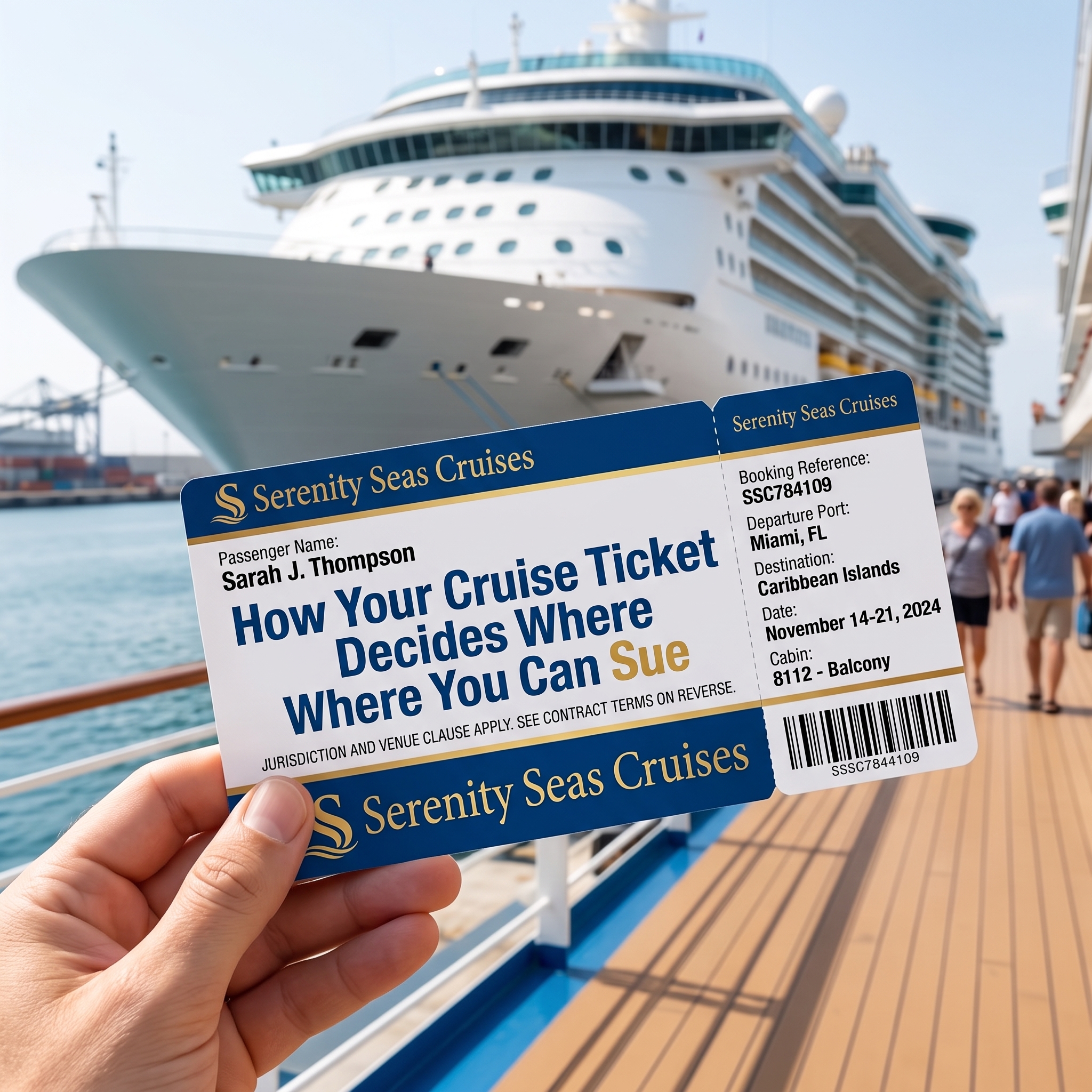
A forum selection clause is a section of your passenger ticket contract that names the court where any lawsuit against the cruise line must be filed. It is usually a single paragraph, often under a heading such as “Jurisdiction,” “Venue” or “Forum Selection.”
A typical clause names a specific federal court, then names a state court in the same area as a backup if the federal court can’t hear the case. The result is that a passenger from Ohio, hurt on a cruise that left from Texas, may still have to file in a court hundreds of miles from home.
Why courts enforce it
In Carnival Cruise Lines v. Shute (1991), the U.S. Supreme Court upheld a cruise ticket clause that required passengers to sue in Florida. The Court reasoned that cruise lines carry passengers from many places, and naming one court in advance limits confusion and cost.
Since then, courts have generally enforced these clauses as long as the terms were reasonably communicated to the passenger. Courts look at things like whether the terms were easy to find, whether the passenger had the chance to read them before sailing and whether the clause was clearly worded. Having never read the ticket is usually not enough to avoid it.
How to find the clause in your ticket
You accepted the ticket contract when you booked or checked in, so you can usually find it even after the cruise is over.
- Look in your booking documents. Search your confirmation email and e-documents for “Ticket Contract,” “Passenger Contract” or “Terms and Conditions.”
- Check the cruise line’s website. Most lines publish the passenger ticket contract online, often linked in the site footer.
- Find the right version. Contracts change over time. The version that applies is the one in effect for your sail date.
- Search for key words. Look for “forum,” “jurisdiction,” “venue” and “exclusively.” The forum clause is often near the sections on time limits and notice of claims.
- Save a copy. Download or screenshot the full contract and note the date you accessed it.
Can’t find your ticket contract?
We can locate the version that applies to your cruise and tell you which court it names. The call is free.
Where cruise lines usually require you to sue
The named court usually depends on where the cruise line is based. Several major lines, such as Carnival Cruise Lines, Royal Caribbean International and Norwegian Cruise Line, are headquartered in the Miami area, and their tickets commonly require injury lawsuits to be filed in federal court in Miami. Other lines name courts in other states, and some cruises that never touch a U.S. port name a court in another country.
| What the clause may say | What it usually means |
|---|---|
| A named U.S. federal court | The lawsuit must be filed in that specific federal court, wherever you live |
| A backup state court in the same county | Used if the federal court can’t hear the case |
| A court in another country | More common on cruises that start and end outside the U.S. |
| Arbitration instead of court | Some tickets require arbitration for certain types of claims |
Don’t assume your cruise follows the pattern. Read your own ticket, or have an attorney review it.
What happens if you file in the wrong court
If a lawsuit is filed somewhere other than the court the ticket names, the cruise line will usually ask the judge to dismiss the case or move it. A transfer costs time. A dismissal can be worse, because the one-year filing deadline keeps running.
Other ticket terms that come with it
The forum clause rarely stands alone. The same contract usually includes other terms that shape a claim:
- Written notice deadline. Many tickets require written notice of a claim within six months of the injury.
- Lawsuit deadline. Many tickets require a lawsuit to be filed within one year.
- Choice of law. Tickets often state that general maritime law applies, not the law of your home state.
- Class action waiver. Many tickets require each passenger to bring their own individual claim.
- Arbitration. Some tickets send certain claims to arbitration rather than court.
When the clause may not apply
Courts rarely set these clauses aside, but there are situations where the answer is less certain:
- The terms were not reasonably communicated, for example if the passenger had no real chance to see them before sailing.
- The claim is against someone other than the cruise line, such as an independent excursion operator, whose own terms may differ.
- The clause is unclear about which court or which types of claims it covers.
These arguments depend heavily on the facts and the exact wording of the ticket, so they are worth raising with an attorney early rather than relying on them.
Frequently asked questions
Do I have to sue in Miami if I live in another state?
Often, yes. If your ticket names a court in Miami, that is usually where the case must be filed, even if you live elsewhere and the cruise left from another port. Your own ticket controls, so check the exact wording.
I never read the ticket contract. Am I still bound by it?
In most cases, yes. Courts generally enforce the terms if the cruise line made them reasonably available before you sailed, whether or not you actually read them. This usually applies to everyone in your booking, including people a family member or travel agent booked for.
Does the clause apply if I was hurt on a shore excursion?
A claim against the cruise line is usually covered by the same clause. A claim against a local tour operator may follow different rules, and some excursion contracts have their own terms. An attorney can tell you who can be sued and where.
Can my local lawyer handle the case?
Only if they can practice in the court your ticket names. Many people work with a firm that regularly handles cases in that court, sometimes alongside their own local attorney.
What if my cruise started outside the United States?
Some tickets for cruises that never touch a U.S. port name a court in another country. Read the forum selection section closely, because the rules can depend on where the cruise began and ended.
This article is for general information only and is not legal advice. Reading it does not create an attorney-client relationship. Every case depends on its own facts and the terms of the passenger ticket.
Hurt on a cruise?
Most cruise tickets give you one year to file. Talk to a maritime attorney about your case today.
Call (888) 866-5303Free and confidential
Related practice areas
More from the blog
All articles
What does “man overboard” mean on a cruise ship?
A man overboard call means a person has gone into the water and a search begins. Learn what the alert means, how a ship responds, and what witnesses and families should do.
What is the most common injury on a cruise ship?
Falls are among the most common injuries passengers report on a cruise ship. See what the research shows, where injuries happen, and how to lower your risk of injury.

Cruise Ship Medical Care: What the Line Owes You
After a cruise ship injury, the ship sails on and the clock starts. Learn what medical care the line owes you, what it does not cover, and when care falls short.