
What Does a CDC Cruise Ship Sanitation Score Tell You?
A number out of 100 sounds like a safety rating, but it is a snapshot of one day. Here is how to read it, what it leaves out, and what to do if you get sick.
TL;DR:
- The score is out of 100: The CDC’s Vessel Sanitation Program inspects cruise ships, and a score of 85 or below does not pass.
- It is a snapshot: The score reflects the day of one inspection. It does not predict whether you will get sick.
- You can check it yourself: The CDC publishes the score, the date and the notes for each inspected ship.
- Norovirus spreads easily on ships: Washing your hands with soap and water and telling the medical center if you are sick are the basics.
- Getting sick is not enough for a claim: Only some cases involving illness outbreaks on cruise ships turn on what the cruise line did or failed to do.
Cruise ships that call at U.S. ports are inspected by the CDC, and every inspection ends in a score. The CDC’s Vessel Sanitation Program rates each inspected ship out of 100, and a score of 85 or below does not pass. That number is a snapshot of one inspection day. It is useful, but it does not predict whether you will get sick on your cruise.
This article explains what the score means, how to check one, what it cannot tell you, how norovirus spreads on ships, what to do if you get sick and when an illness on a cruise may support a claim. It does not rate any ship or cruise line, and it is not medical advice.
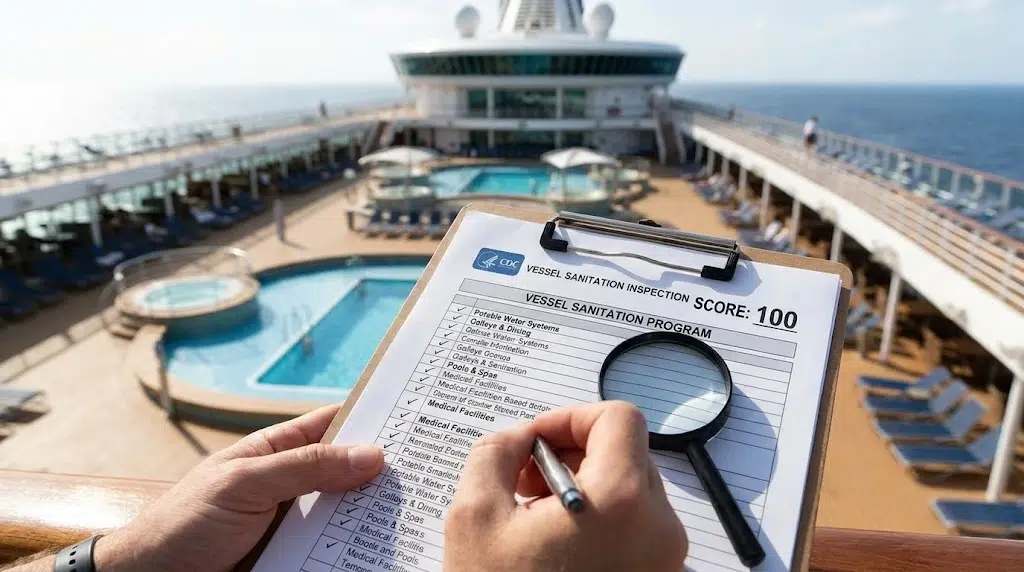
What Does a CDC Cruise Ship Sanitation Score Mean?
The CDC uses a 100-point scale. Inspectors deduct points for violations, whether it is one significant violation or the same kind of violation repeated. A ship fails an inspection when it scores 85 or below, so a score of 86 or higher is a passing result. Ships must correct what inspectors find, and critical violations must be fixed immediately.
Two things matter as much as the number. The first is the date, because the score describes the ship on the day it was inspected and nothing after. The second is the notes, because a score does not say what the violations were, and a ship that scores well can still have a problem worth reading about.
The scale and the passing score described here are taken from the CDC’s public information and can change. Always check the CDC’s own pages for the latest details.
What Is the CDC Vessel Sanitation Program?
The Vessel Sanitation Program is a CDC program that inspects cruise ships and publishes the results. Its inspections are periodic and unannounced, and they take place while a ship is in a U.S. port. A typical inspection lasts several hours, and ships under the CDC’s jurisdiction are subject to two inspections each year. A ship that spends a long period sailing outside the United States may not receive two in a year, and it is inspected again when it returns.
Inspectors check conditions against public health standards in areas such as food safety, drinking water and housekeeping. When something is out of compliance, they tell the ship’s staff and the ship must correct it. The goal is to keep illness from spreading in a setting where thousands of people eat, sleep and share space for days.
How to Check a Cruise Ship’s Sanitation Score
You do not need to guess. The CDC lists each inspected ship’s score and report in its public inspection database. Here is how to use it.
- Search by ship name: Use the ship’s name, not the cruise line’s.
- Find the most recent inspection: Look at the date first, because an old score tells you little about the ship today.
- Read the score: Remember that 85 or below does not pass.
- Open the report: Read the notes on violations and on how the ship corrected them.
- Compare earlier inspections: A pattern of the same problem can say more than a single result.
| What you see in the report | What it tells you |
|---|---|
| Inspection date | How recent the snapshot is |
| Score | The overall result on that day, out of 100 |
| Violations | What inspectors found, and whether it was minor or serious |
| Corrective actions | How the ship said it fixed the problems |
| Earlier inspections | Whether a problem is new or keeps coming back |
If a ship does not appear in the database, it may be outside the CDC’s jurisdiction or sailing outside the United States for an extended period.
What a Cruise Ship Sanitation Score Cannot Tell You
A score is a helpful piece of information, but it has limits. It cannot tell you:
- Whether you will get sick: People fall ill on ships with high scores, and many people stay well on ships with lower ones.
- What happened after the inspection: Conditions can change in the weeks and months that follow.
- Whether a particular outbreak is linked to a lapse: An outbreak can start when a person boards already carrying a virus, whatever the ship’s score.
- What the cruise line did when illness appeared: How quickly it isolated sick passengers, warned guests and cleaned is not part of the number.
That is why the score is a starting point, not a verdict.
Norovirus on Cruise Ships in Plain Terms
Norovirus is a very contagious stomach illness, and the CDC notes that it spreads quickly in closed and semi-enclosed spaces such as cruise ships. A person who boards already carrying the virus can pass it to other passengers and crew. The CDC defines an outbreak on a ship as 3 percent or more of passengers or crew having specific gastrointestinal symptoms.
The basics of prevention, based on the CDC’s norovirus prevention guidance and its cruise ship guidance, are simple:
- Wash your hands often with soap and water: scrub for at least 20 seconds. The CDC says hand sanitizer does not work well against norovirus and should not replace washing.
- Tell the ship’s medical center if you are sick: stay in your cabin if they tell you to, which protects young children, older adults and people with weakened immune systems.
- Leave the area: move away if you see someone vomiting or having diarrhea.
- Drink plenty of fluids and rest: do this if you are ill, and see a doctor if you get sick after the trip, mentioning your recent cruise.
This is general information and not medical advice. For symptoms that worry you, ask the ship’s medical staff or your own doctor.
Got sick on a cruise?
We can look at what happened and tell you which deadlines may apply. The call is free.
What to Do If You Get Sick on a Cruise
If you start to feel sick on board, your health comes first. The steps below also create a record that matters if you later decide to ask questions.
- Go to the medical center: Report your symptoms, and ask for a record of the visit. What to expect is covered in cruise ship medical care.
- Report it to the ship: Tell guest services as well, so there is a record of when and how you reported.
- Keep receipts: Save bills for medical care, medicine, missed excursions and any costs from the illness.
- Write down what you ate and when your symptoms began: Include where you ate and who was with you.
- Note who else was sick: Names and contact details of other passengers can matter later.
- Keep your documents: Save your ticket, messages from the cruise line and any notices about illness on board.
These steps are an illness version of what to do in the first 24 hours after a cruise injury, and they matter most early, while memories are fresh. If you want to understand how to give notice, who to notify and who to sue explains the process.
When Getting Sick on a Cruise May Support a Claim
Only some illnesses on a cruise support a legal claim. A bad outcome alone is not enough. Many illnesses are caught on land and carried aboard, and ships cannot prevent every case.
What matters is the cruise line’s conduct. Questions that can matter include whether the ship ignored known problems, whether sick passengers were isolated and guests were warned, whether cleaning and food handling met reasonable standards and whether medical care was adequate. A low inspection score on its own does not prove a claim, and a high score does not rule one out.
If you think your illness may be more than bad luck, keep your records and ask a lawyer to review them early. The ticket often sets short time limits, which are explained in how long you have to sue a cruise line, and waiting can make it harder to gather what you need.
Frequently Asked Questions
What is a good CDC sanitation score for a cruise ship?
The CDC scores ships on a 100-point scale, and a ship fails an inspection when it scores 85 or below. A higher score generally means fewer or less serious violations on the day of the inspection. The number alone does not guarantee a healthy trip, so check the inspection date and the notes as well.
Does a low score mean I will get sick?
No. A low score shows that inspectors found problems on the day they inspected, and it is worth taking seriously, but it does not mean you will get sick. A high score does not mean you will stay well either. The score reflects one inspection and does not predict illness.
Can I make a claim if I got sick on a cruise?
Possibly, but only some illnesses support a claim. Getting sick is not enough by itself. What matters is whether the cruise line failed to take reasonable steps, and the facts, your records and the ticket terms all play a part. Keep your medical records, receipts and notes, and ask a lawyer to review them early.
Where can I check a cruise ship’s sanitation score?
The CDC publishes inspection scores and reports for ships it inspects in a public online database. Search by ship name and read the most recent inspection date, the score and the notes. If a ship does not appear, it may be outside the CDC’s jurisdiction or sailing outside the United States for an extended period.
This article is for general information only and is not legal advice or medical advice. Reading it does not create an attorney-client relationship. It does not rate or criticize any ship or cruise line. CDC details are as published by the CDC at the time of writing and can change, so check the CDC’s pages for the latest information. Every case depends on its own facts and the terms of the passenger ticket.
Hurt on a cruise?
Most cruise tickets give you one year to file. Talk to a maritime attorney about your case today.
Call (888) 866-5303Free and confidential
Related practice areas
More from the blog
All articles
268 Sick on the Caribbean Princess: Norovirus Confirmed After the Ship’s Second Outbreak This Year
The CDC now reports 268 sick on Princess Cruises’ Caribbean Princess and names norovirus as the cause. See how the count grew and what to do if you get sick on a cruise.

Man Overboard From Royal Caribbean’s Allure of the Seas: What Has Been Reported and How the Search Works
A man went overboard from Royal Caribbean’s Allure of the Seas off the Bahamas and the ship turned back to search. Here is what was reported and how overboard searches work.

Coast Guard Airlifts Passenger From Holland America’s Koningsdam: What Happened 80 Miles Off San Diego
The Coast Guard airlifted a 74-year-old passenger from Holland America’s Koningsdam about 80 miles off San Diego. Here is what was reported and how airlifts at sea work.
0 Comments