
What does "man overboard" mean on a cruise ship?
A man overboard call starts an immediate search. Here is what the words mean, how a ship responds, what witnesses should do, and what families should know about the legal side.
TL;DR:
The short version of this guide
- “Man overboard” means a person is in the water. They may have fallen, jumped or been pushed, and crews use the term to start a search and rescue at once.
- Many ships use a code word, often “Oscar,” but not every line uses the same words.
- A ship marks the position, turns back, posts lookouts, launches rescue boats and alerts the authorities.
- U.S. law addresses detection technology, but the wording is narrower than many people expect.
- Witnesses and families both have clear first steps, and preserving video and records early matters.
On a cruise ship, “man overboard” means that a person has fallen, jumped or been pushed off the ship and into the water. Crews also say “person overboard.” The term works as an alarm, often as a coded announcement, and it starts an immediate search and rescue.
This is a difficult subject to read about, and you may be here for a personal reason. You might have heard an announcement on your own sailing, seen something from the deck, or be waiting for news about someone you love. We have tried to keep this guide clear and plain: what the words mean, what a ship does, what the law says about detection, what a witness should do, and what a family should do first.
Every overboard incident on a cruise ship turns on its own facts, so please treat this guide as general information rather than an answer to a specific event.
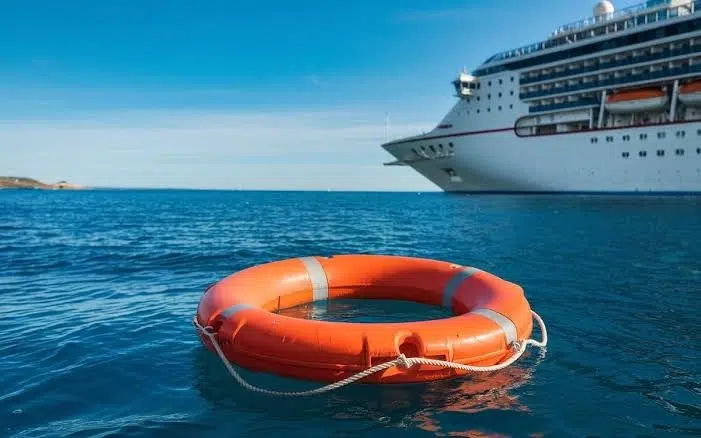
What a man overboard cruise ship announcement sounds like
Many ships use a code word instead of announcing “man overboard” over the speakers, so as not to alarm guests. The word most often used is “Oscar.” It comes from the international signal flag for the letter O, which stands for a person overboard. You may hear it said as “Oscar,” or as “Code Oscar,” sometimes repeated and followed by a location.
Not every line uses the same words, and practices differ between ships. Some announcements are made over the public address system, and some are directed only at crew. Depending on the line, a passenger may notice the alert only indirectly: a sudden change in the ship’s engines, a turn, crew moving quickly to the rails, or searchlights on the water.
What the ship does
Procedures differ by line and by ship, and the captain makes the key decisions. In general terms, a response to a person in the water follows these steps:
- Raises the alarm and calls crew to their stations.
- Marks the position where the person went into the water, so the search can begin in the right place.
- Turns back toward the area. A large ship cannot stop or turn quickly, which is one reason every minute matters.
- Posts lookouts on the decks and bridge wings to watch the water.
- Launches rescue boats when conditions allow.
- Alerts the Coast Guard and other authorities, and nearby vessels that can help.
- Reviews camera footage to confirm what happened and when.
Someone pulled from the water is taken to the ship’s medical center, where cruise ship medical care is limited to basic emergency treatment, or transferred ashore, depending on their condition. Cold water, darkness and rough seas make every rescue harder, and drowning is a real risk, which is why some of these events lead to a cruise ship drowning accident claim.
Cruise Ship Overboard Detection: What the law requires
One of the most common questions we hear from families is how a person could go overboard without anyone noticing. Part of the answer lies in what the law requires, and it is narrower than many people expect.
The Cruise Vessel Security and Safety Act of 2010 (CVSSA) requires covered passenger vessels to use available technology to capture images of passengers or detect passengers who fall overboard. However, this does not necessarily mean every ship must have automatic detection systems that immediately alert the crew.
The international standard ISO 21195 is associated with a 95% detection-rate benchmark, but this is not a universal U.S. legal requirement.
Detection technology matters because delays in discovering an overboard incident can affect rescue efforts. Investigators may examine surveillance footage, navigation records, available detection systems, and crew response to determine whether the cruise line met its legal obligations.
If you see someone go overboard
If you see a person go over the side, the first seconds count. These steps are widely taught for witnesses:
- Alert the crew at once. Shout, and send someone to the nearest crew member or ship phone. Do not assume someone else has already raised the alarm.
- Keep your eyes and your arm pointing at the person. Do not look away. The spot is very hard to find once you lose sight of it, so if you are with others, have one person keep pointing while another gets help.
- Throw a life ring if one is close. Only do this if it is within easy reach and safe to do.
- Note the time and place. Remember the deck, which side of the ship and anything nearby, such as a lifeboat or sign.
- Stay available. Tell the officers or security what you saw, and write it down as soon as you can while it is fresh.
What Families Should Do After a Cruise Ship Overboard Incident
If someone you love has gone overboard, you may be dealing with fear, shock and very little information. You do not have to do everything at once. These steps help protect what matters for later:
- Contact the cruise line and ask who is handling the case. Write down the names of the people you speak to, with the date and time.
- Contact the authorities. That includes the U.S. Coast Guard and, in some cases, other agencies. If the person was not an American citizen, their country’s consulate may also be able to help.
- Ask in writing that video and records be preserved. That includes camera footage, the ship’s position and navigation records, incident reports, crew statements, key-card and cabin records, and the person’s belongings. Footage can be overwritten if no one asks.
- Keep everything you have. That means the booking confirmation, ticket, emails, messages and photos from the trip.
- Speak to a maritime attorney. Choose one who handles cruise ship wrongful death claims and can explain how families can seek answers and accountability.
If there is any reason to believe someone else was involved, the case may also raise questions of assault and security on cruise ships, such as whether the line took reasonable steps to keep passengers safe.
Lost someone at sea and unsure where to begin?
We can explain your options and which deadlines apply, and help you ask for records to be preserved. The call is free.
Why these cases are hard
Overboard cases are among the most difficult we see, and families should know why, so they are not surprised.
- Evidence can be limited. Many incidents happen at night, away from other people, and there may be no witness. Footage and records may be incomplete, or may be overwritten if no one asks for them early.
- Delays matter. A late detection or a late search can change the outcome, and it can also change what can be proven afterward.
- The cause may be unclear. Whether a person fell, jumped or was pushed affects how a case is approached.
- The ticket sets the rules. Its terms affect where you can sue a cruise line and how quickly a case must be filed.
- The law that applies can vary. It may depend on factors such as where the ship was when it happened.
None of this means a family has no options. It means that early advice and early preservation of evidence make a real difference.
Frequently asked questions
What is “Code Oscar”?
“Oscar” is the international signal flag for the letter O, which stands for a person overboard. Many cruise ships use “Oscar” or “Code Oscar” as a coded announcement to start a search and rescue. Not every line uses the same words, and some announcements are directed only at crew.
How often do people go overboard?
No one number is agreed. Counts differ depending on who collects them and whether they include falls, jumps and rescues, and there is no single public source that covers every cruise line. Treat any figure with caution, and ask where it comes from.
Can a family make a claim if a passenger goes overboard?
Possibly. It depends on how it happened, what the cruise line did before and after, and the terms of the ticket, including its deadlines. Wrongful death claims also have their own rules about who may bring them and which law applies, which is why early advice matters.
This article is for general information only and is not legal advice. Reading it does not create an attorney-client relationship. Every case depends on its own facts and the terms of the passenger ticket.
Hurt on a cruise?
Most cruise tickets give you one year to file. Talk to a maritime attorney about your case today.
Call (888) 866-5303Free and confidential
Related practice areas
More from the blog
All articles
What is the most common injury on a cruise ship?
Falls are among the most common injuries passengers report on a cruise ship. See what the research shows, where injuries happen, and how to lower your risk of injury.

Cruise Ship Medical Care: What the Line Owes You
After a cruise ship injury, the ship sails on and the clock starts. Learn what medical care the line owes you, what it does not cover, and when care falls short.
Who to Notify and Who to Sue After a Cruise Injury
Hurt on a cruise? Tell the ship right away, then give the cruise line the written notice your ticket requires. We explain who to notify, who can be held responsible, and where a case has to be filed.